Home » Move a Manufacturing Prototype into Production with Fewer Handoff Gaps
Move a Manufacturing Prototype into Production with Fewer Handoff Gaps
Contents
A promising prototype can still fail at production release. A drawing may not include a usable datum scheme, a supplier may not be able to hold a required tolerance, or the assembly team may discover that a fastener cannot be installed with the available access. These problems become expensive when design, manufacturing, quality, purchasing, and suppliers work from different assumptions.
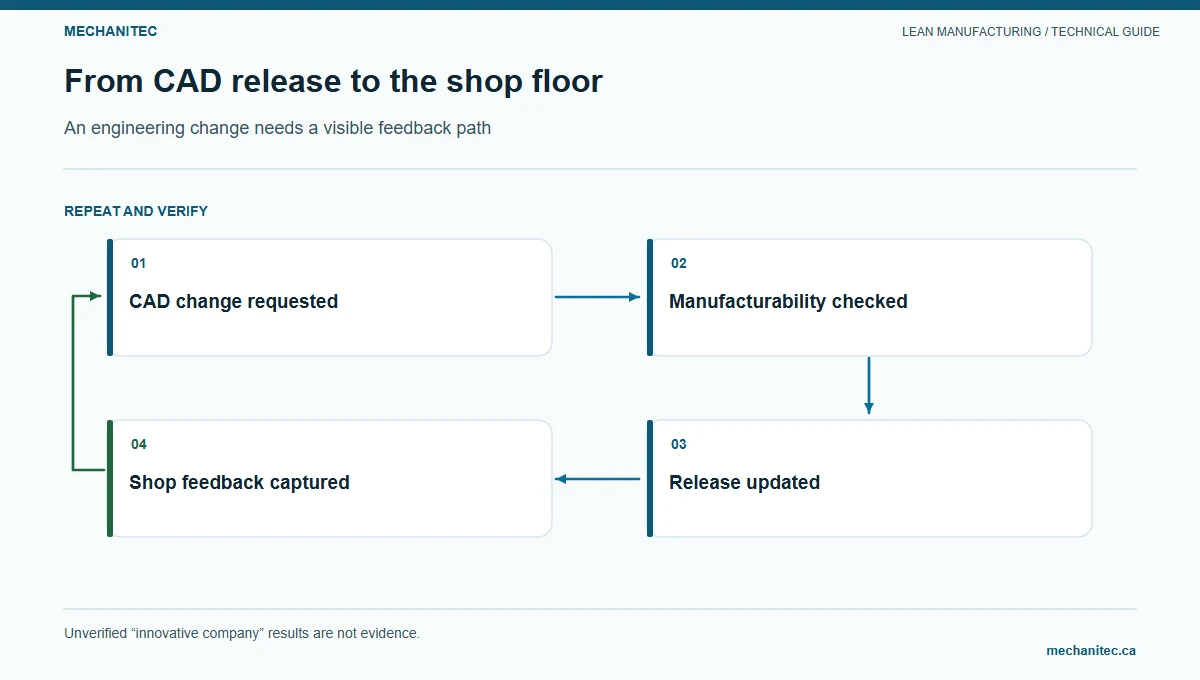
This guide gives a product team a controlled way to move from prototype learning to a production-ready release. It covers design-for-manufacturing feedback, issue ownership, work-in-progress visibility, and release evidence. The engineering example is illustrative; it does not describe a named innovative company or report actual cycle-time results.
Prototype learning reaches production only when findings change controlled design and process records.
Start with the product and release boundary
Choose one product or subassembly and define what “production release” means for it. It might include an approved drawing set, bill of materials, routings, inspection plan, supplier specifications, work instructions, tooling, training, and a completed validation. Use the organization’s actual release criteria; this list is not a universal substitute for industry or customer requirements.
Name the events the team will measure: prototype request accepted, design package ready for review, prototype built, issues logged, corrective design released, pilot build accepted, and production authorization. Keep design active time, waiting for decisions, supplier delay, build time, and rework separate. If several product variants follow different approvals, track them separately.
At the first review, identify the customer use case, performance requirements, interfaces, materials, expected volume and mix, manufacturing constraints, inspection needs, and known risks. Confirm which requirements are stable and which remain assumptions. A prototype can test an assumption; it cannot silently replace an approved requirement.
Bring manufacturing and quality feedback forward
Invite production, manufacturing engineering, quality, procurement, maintenance, and the supplier where appropriate before the design is locked. Ask them to review the features they control: access for assembly and inspection, process capability evidence, material availability, joining sequence, tooling, maintenance access, packaging, traceability, and likely failure modes.
Make the review specific. Instead of “Is the design manufacturable?”, ask “Can the operator install this fastener with the specified tool and keep the adjacent cable clear?” or “Which characteristic will quality measure, with what instrument, and where will the record be stored?” Include the CAD view, revision, interface requirements, and the decision requested.
Keep alternatives visible when evidence is incomplete. The Lean Enterprise Institute’s set-based concurrent engineering reference describes developing feasible options and narrowing them as the team learns. The team can compare design paths against constraints rather than selecting one concept prematurely. It should still identify who owns the final decision and what test will resolve uncertainty.
Maintain a design-for-manufacturing issue tracker
Each issue should describe a condition, not a personal criticism. Capture the feature or interface, product and revision, evidence from a prototype or review, likely effect, urgency, owner, next action, decision authority, due date, and disposition. Link to controlled files by identifier instead of uploading unofficial duplicates to the tracker.
Example design-for-manufacturing issue record
Field
Record
Issue ID and revision
Unique identifier, part or assembly, and exact drawing/CAD revision
Observed condition
What happened during build, inspection, service, or supplier review
Requirement and evidence
Requirement source, sample or test record, measurement method, and limits
Effect and risk
Fit, function, safety, quality, cost, delivery, serviceability, or compliance concern
Owner and decision
Person responsible for analysis, approver, and specific question to resolve
Action and due date
Test, supplier response, calculation, or design change with a review date
Disposition
Accepted, changed, deferred with rationale, or rejected with evidence; affected records identified
Assign one accountable owner per issue. Several functions may contribute, but shared ownership without a decision owner can make a tracker look active while no one closes the item. Review urgent safety, regulatory, and customer risks through formal controls. The tracker organizes the work; it does not replace an approved risk file or change request.
Use a short evidence review before closing each item. Ask whether the evidence came from an actual build, a measurement, a supplier record, a calculation, or an assumption. State the sample and the conditions under which it applies. If a finding applies to one prototype configuration, do not transfer it to every variant without checking interfaces and process differences.
For an unresolved requirement, separate “not yet verified” from “failed.” Record what test or analysis can answer the question, who will perform it, and what result would support each design option. If the team cannot set an acceptance condition, return to the product owner or customer requirement rather than choosing the most convenient option.
When several issues interact, use a dependency map. A tolerance choice can affect supplier capability, inspection method, fixture design, and assembly fit. A change to one feature may invalidate prior test results. Link related items and identify the order in which they must be resolved; do not close a downstream issue before its input is stable.
Control the design and production work queue
Show requests and findings in a shared board with states such as intake, analysis, ready for decision, design change, validation, and released. Use one state definition for every team. Keep “waiting for supplier data” visible instead of leaving it in “design.” Note the person who will make the next contact and the date to escalate a missing response.
Limit active design changes so engineers and reviewers can finish evidence and update connected records. The limit should reflect the available technical and approval capacity. If it is exceeded, pause lower-priority work or obtain a decision on priorities rather than opening a hidden queue. Record urgent exceptions and review why they occurred.
Pull a design review when the package is complete enough for a decision. The review request should include the current revision, open issue list, test evidence, affected interfaces, and exact choices. If a key input is missing, state it and assign an owner; a meeting cannot resolve information the team has not collected.
Keep task estimates and review promises separate from customer commitments. An engineer may estimate effort for a drawing change, while an unresolved supplier test makes the release date uncertain. Show the dependency and ask the authorized owner to decide whether to wait, prototype an alternative, or adjust the launch plan.
Map both the product information and the physical sample. Record where the sample is, who can modify it, how it is identified, and which revision it represents. A test result is useful only when the team can connect it to the correct design and build conditions.
At the weekly review, check items that moved backward as well as those marked complete. Reopened work can reveal that an approval gate or requirement was misunderstood. Ask the owner what evidence changed and update the checklist so later transfers benefit from the lesson.
Record the decision in the same controlled project record used by the downstream teams. A verbal agreement may be useful for discussion, but it cannot replace the released revision or approved disposition.
Illustrative design iteration with two feedback rounds
Illustrative example — not observed product performance. A team prototypes a small sheet-metal enclosure. In the first build, an operator reports that one mounting screw is difficult to install because the tool path is blocked by a formed flange. The inspection technician also finds that the drawing datum does not match how the part is located in the fixture.
Feedback round 1: The design engineer records both findings against the prototype revision. Manufacturing engineering measures access on the assembled part and reviews two flange alternatives. Quality reviews the proposed datum scheme and identifies the inspection method. The team tests the alternatives on a revised sample and records installation steps, fit, and inspection repeatability. It does not change the drawing until the process and quality owners approve the evidence.
Suppose, only for illustration, that the first prototype-to-decision interval is 12 working days. The team should break that interval into design work, waiting for access feedback, sample build, and review delay. It should not claim a 12-day “engineering cycle time” unless the start and stop events include all those steps by definition.
Feedback round 2: A supplier review finds that the selected bend tolerance is not supported by the planned process at the expected order mix. Procurement obtains the supplier’s documented capability and quotation assumptions; engineering checks whether a design adjustment can meet function with a more robust tolerance; quality confirms the verification plan. The product owner decides which option meets the customer requirement and authorizes the next sample.
The issue tracker records the decision, evidence, drawing change, supplier document, inspection plan update, and who approved each record. The team may calculate the elapsed time between released revisions, but it must show the number of iterations and define whether supplier waits are included. A short interval is not inherently good if the team skipped verification.
Set production release gates
Before a pilot or production release, confirm the specific requirements for the product and site. Depending on the product, release evidence may include approved design records, verified critical characteristics, material and supplier approvals, process instructions, inspection capability, operator qualification, tooling readiness, traceability, packaging, maintenance, and service information.
For every open issue, require one disposition: resolved with evidence, accepted by an authorized approver with documented rationale, deferred outside the current release scope with controls, or rejected with evidence. Do not treat “we will fix it later” as a disposition. Check whether a change affects other parts, product variants, inventory, purchased material, software or firmware, customer approvals, or already released documents.
Use a change-control route for released designs. Identify the effective date or serial/lot boundary and the production records that must change. Make sure the new revision reaches the controlled repository, supplier, and work area before use. Keep prior revisions retrievable under the organization’s document-retention rules.
Review the transfer after the first production run
After the first authorized build, compare actual results with the release assumptions. Review defects, rework, assembly questions, supplier escapes, inspection findings, material substitutions, and change requests. Ask production employees what was unclear and whether the training matched the released method. Feed valid learning back to design and update the issue record.
When the first run exposes a new issue, contain the risk and follow formal nonconformance or customer procedures. Do not relabel a product change as an informal improvement to avoid review. The production process is part of the design transfer and must remain under the appropriate controls.
Measure release quality alongside time: unresolved high-risk issues at release, change-related defects, rework hours, first-pass acceptance under the site’s definition, and supplier or customer escalations. Report the product mix and sample size. Early production is a learning period, so a small sample cannot establish long-term capability by itself.
Use this handoff checklist
Define the product, prototype boundary, and release event.
List stable requirements and open assumptions.
Invite manufacturing, quality, procurement, and supplier input at the stage when it can change the design.
Record issues against exact revisions with a named owner and decision authority.
Track blocked work and supplier dependencies visibly.
Validate proposed changes against functional, process, quality, and safety requirements.
Update controlled drawings, bills of material, routings, inspection plans, instructions, and training as required.
Confirm release distribution and first-run feedback before closing transfer actions.
For a related engineering workflow, see the Lean product-development guide for CAD teams and the engineering change handoff guide. The first practical measure is age of open design-for-manufacturing issues by owner and decision stage. It shows where the team needs evidence or authority before the next release decision.