Home » Successful Implementation of Lean Manufacturing in a Machine Shop
Successful Implementation of Lean Manufacturing in a Machine Shop
Contents
In a high-mix machine shop, one job may wait for a saw, brake, weld cell, finish booth, or inspection slot while another job uses a different route. Start by following one repeatable part family from order release to shipment. Record the actual route, queue time, work in process (WIP), and constraint before changing batch size or moving equipment.
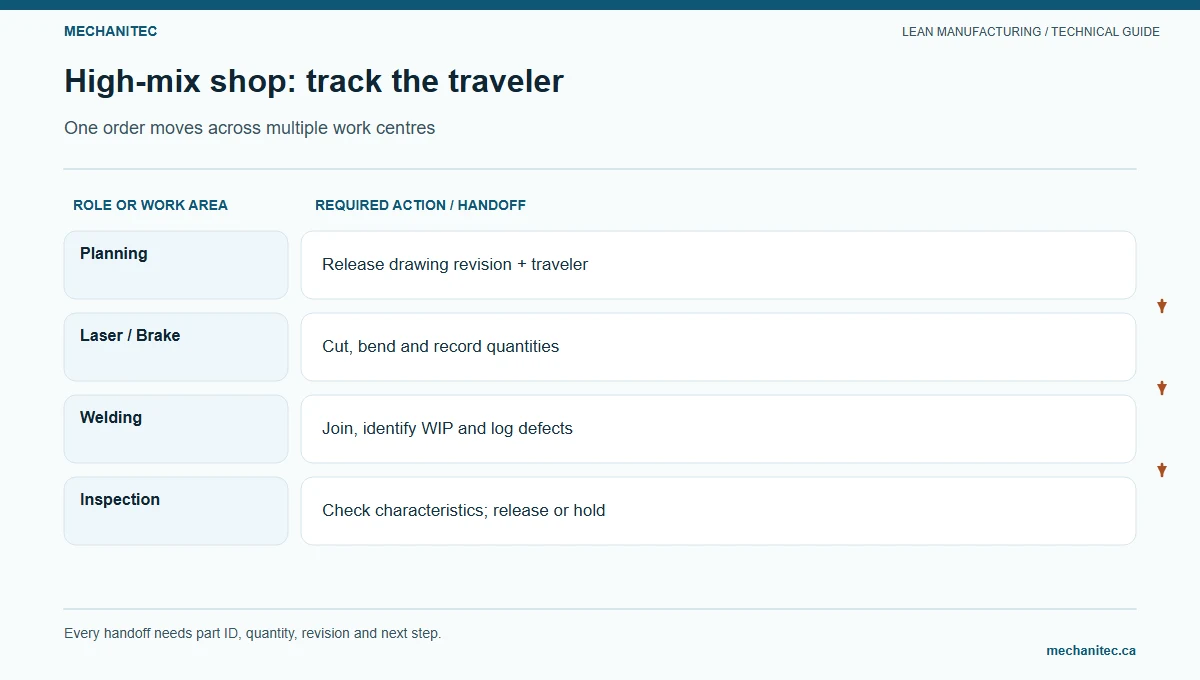
One order moves across multiple work centres. Mechanitec instructional diagram.
This guide gives you a sample routing method, a traveler layout, and a 60-day pilot. The numbers below are illustrative examples, not results from a real shop. A documented NIST MEP example at Lynn Welding shows how a manufacturer used value-stream mapping, kaizen teams, 5S, visual management, smaller batches, and setup reduction; the source does not report the specific 80% lead-time reduction previously claimed on this page. Read the NIST MEP Lynn Welding case.
Map one family from order to shipment
Select a family that shares a similar process route and has enough recent jobs to observe. Walk the route with an operator, planner, and quality representative. Use the current drawing revision and actual travelers. Record each operation, queue location, transfer quantity, setup, inspection gate, and information handoff. Do not map from a routing sheet alone: note what people do when work is missing, held, reworked, or waiting for an outside process.
Illustrative route and handoff for a made-to-order welded bracket family
Step
Work center
Input and owner
Output and check
1
Order release
Planner checks approved drawing, material, quantity, and due date.
Released job packet with revision and route.
2
Laser or saw cutting
Operator verifies material grade, thickness, program, and drawing revision.
Cut parts identified by job and quantity; first-piece check recorded.
3
Press brake
Operator confirms tooling, bend sequence, and setup approval.
Formed parts pass the specified dimensional checks.
4
Welding
Welder checks joint preparation, fixture, weld symbols, and applicable procedure.
Assembly moves to the defined inspection point; nonconforming work is identified and held.
5
Finishing
Finisher confirms required surface treatment and masking instructions.
Finished item with process record where the customer or quality plan requires one.
6
Final inspection and shipping
Quality checks the order’s specified characteristics; shipping checks quantity and documents.
Accepted order is packed and shipped; any hold remains physically and electronically controlled.
This is a sample route, not a required sequence. A real job may skip, repeat, or reorder steps. Keep customer, code, material, weld, and inspection requirements in the controlled job documents. A Lean pilot does not authorize changes to a qualified process or inspection plan.
Use the traveler to control each handoff
Attach one traveler or controlled digital record to the job. It should identify the job, part, revision, quantity, route, operation number, work-center code, required inspection, completion quantity, rejected quantity, date, and responsible sign-off. Use short work-center codes only when the shop has a current legend. Do not use a status color as a substitute for a drawing revision or quality disposition.
Sample traveler excerpt; EX-104 and its values are illustrative
Job / part
Revision
Operation
Code
Move only when
Record
EX-104 / bracket family
C
Cut blank
LAS
Material and first-piece checks pass.
Completed, held, and rejected quantities.
EX-104 / bracket family
C
Form
BRK
Bend dimensions meet the drawing.
Setup confirmation and inspection result.
EX-104 / bracket family
C
Weld assembly
WLD
Current weld instructions and fit-up are verified.
Operator and required inspection sign-off.
EX-104 / bracket family
C
Finish and release
FIN / INS
Finish and specified final checks are complete.
Disposition, quantity, and ship authorization.
If the traveler and drawing disagree, stop the job at a safe state and route the discrepancy to the authorized engineering or quality owner. Never let a WIP target encourage production against an unverified revision.
Find the queue before setting a WIP limit
For one product family, count jobs waiting before each operation at the same time each shift for at least two representative weeks. Record the job’s age and reason for waiting. Mark the current constraint from observed demand and capacity; do not assume the machine with the largest queue is always the constraint. A queue can also reflect missing material, late engineering information, inspection capacity, or a deliberate batch.
Illustrative queue snapshot for one family; replace it with observed shop data
Queue before
Jobs waiting
Oldest wait
First question
Cutting
3
1 shift
Is the release packet and material ready?
Bending
4
2 shifts
Are setup batches delaying the next job?
Welding
10
4 shifts
Is welding the constraint, or are fit-up, labor, or inspection limiting completion?
Finishing
2
1 shift
Are finish requirements and outside-process dates visible?
Inspection
3
2 shifts
Are acceptance criteria and inspection capacity clear?
After confirming the constraint, pilot a visible cap on jobs released to that queue. Choose the cap from measured throughput, replenishment time, product mix, and safety or quality controls. A cap is a trial control, not a universal number. If work repeatedly exceeds it, stop adding jobs and resolve the cause with the planner and constraint owner instead of hiding the queue elsewhere.
Estimate flow time with Little’s Law
Under stable average conditions, Little’s Law relates average WIP, average throughput, and average flow time: average flow time = average WIP ÷ average throughput. Keep the units consistent and define the same system boundary for all three measures.
Illustrative calculation only; these are not observed shop results
Measure
Example value
Baseline average WIP
40 jobs
Average completed throughput
5 jobs per production day
Estimated baseline average flow time
40 jobs ÷ 5 jobs/day = 8 production days
Illustrative bounded-pilot WIP condition
20 jobs
Illustrative flow-time estimate if throughput stays 5/day
20 jobs ÷ 5 jobs/day = 4 production days
This comparison is arithmetic, not a promised reduction or evidence that a WIP cap caused flow time to change. It assumes a stable average, unchanged throughput, one consistently defined job family, and the same route boundary for WIP and completions. A lower WIP count with lower throughput may not improve delivery. Measure actual elapsed time by job and check late orders, shortages, holds, rework, and queue movement as a cross-check.
Run a 60-day pilot with a clear stop rule
Example pilot plan; owners should adapt dates and controls to the shop
Days
Owner
Work
Evidence to review
1–10
Planner and operators
Select one family; confirm revision controls; map the actual route and record queue, setup, defects, and elapsed time.
Signed current-state map and baseline definitions.
11–20
Constraint owner and quality
Check the largest two sources of lost capacity. Separate waiting for material, setup, maintenance, engineering, and inspection.
Loss log with causes, not only a utilization percentage.
21–30
Cross-functional pilot team
Test one small change, such as an approved setup preparation or a visible WIP cap. Keep the existing safety and quality controls.
Change record, training, and agreed measures.
31–45
Supervisor and team
Run the pilot across representative jobs and shifts. Review exceptions daily; do not bypass required inspection or release gates.
Queue age, completed jobs, first-pass acceptance, and exceptions.
46–60
Process owner
Compare with baseline, record unintended effects, and decide whether to adopt, adjust, or stop the change.
Documented decision, owner, and next review date.
When this method needs adjustment
For one-off, highly engineered jobs, a repeating pull loop may not fit. Use job-specific planning and control engineering release and material readiness.
When demand, routes, or outside processing vary widely, segment families and use actual replenishment data. Do not combine unlike work into one average.
When a queue grows because of a quality hold, protect traceability and disposition first. Never release held parts to improve flow metrics.
When the constraint moves, remeasure the system. Raising output at one machine can create more WIP at another step.
For a broader current-state and future-state map, see the value-stream mapping guide. Select a single family, walk its route, and record the queue and the reason for each wait before authorizing a change.
Control job release and WIP ownership
A WIP limit works only when the shop agrees who can release a job, what counts as a job in the queue, and how an exception is handled. For a high-mix family, the planner checks that the drawing revision, material, quantity, route, and due date are ready before release. The receiving process confirms the job has arrived and updates its status. The area owner tracks the queue count and oldest age. The supervisor resolves priority conflicts; quality controls product holds; engineering controls drawing or process changes.
Define priority rules before adding a board. The shop may use due date, customer priority, or an approved dispatch rule, but it should not allow each work center to choose its own urgent job without a shared policy. Mark jobs awaiting material, engineering, inspection, outside processing, or rework with a clear status and owner. A held job remains in the physical and electronic hold process, not hidden outside the WIP count. Report normal WIP and blocked/held work separately and make the total route exposure visible.
Example machine-shop WIP board fields and ownership
Board field
Entry rule
Primary owner
Job and product family
Use controlled job and part identifiers; do not combine unlike routes.
Planner
Drawing revision and route
Match the released packet; record approved route changes.
Engineering/document control
Current operation and status
Ready, in process, awaiting inspection, held, or complete under local definitions.
Work-center operator
Queue position and age
Timestamp entry; preserve oldest job and reason for wait.
Queue owner
Release authorization
Release only within the agreed limit and readiness rules.
Planner/supervisor
Exception and next check
Name the material, quality, engineering, or capacity decision owner.
Supervisor with support role
Choose a cap from measured throughput, replenishment time, route variability, and process risk. Do not select a round number because it fits on the board. During the pilot, a job entering a capped queue waits at an approved upstream location with identity and status visible. The team then confirms the condition that will release the next job. If the queue repeatedly exceeds the cap, investigate whether unauthorized release, batch transfer, measurement timing, or an unrecorded hold is responsible.
Keep traveler events consistent across the route
The traveler should record when a job is released, started, completed, inspected, held, reworked, and transferred under the site’s actual system. Define which events update the shop-floor board and who records them. A “completed” quantity cannot include pieces still waiting for required inspection. For a split lot, show the quantity in each disposition and retain traceability to the same job. Physical containers and the controlled record must reconcile before the next operation receives work.
At shift change, the outgoing and incoming operators review work currently in process, open holds, setup condition, tooling or fixture status, and the next authorized action. If a job has been partially processed, note completed and remaining quantities, current operation, and any first-piece or in-process inspection required. The next shift should not infer status from a cart location or colored tag alone.
When work leaves for coating or another outside process, the traveler or approved system records send date, expected return, supplier/process owner, revision or specification, quantity, and received condition. If the operation is a batch, include the planned batch window and the rule for urgent orders. Confirm the accepted count and any damage, shortage, or quality hold on receipt before making the job available to downstream work.
Review the 60-day pilot in phases
During days 1–10, select a recurring family and capture the actual route, WIP, oldest queue age, transfer batch, setup, good output, rework, and exception reason. Validate the map with each work center and set a fixed count time. During days 11–20, identify the suspected constraint and separate capacity loss from missing release information, material, outside processing, or inspection. Do not use utilization alone to declare the bottleneck.
During days 21–30, choose one change with the affected operators and required support roles. A setup-preparation trial may be appropriate if observation shows that approved tools or documents are missing at changeover. A WIP cap may fit if the queue is feeding the verified constraint and the team has a release signal. Write down the owner, affected jobs, start date, measure, guardrails, and rollback condition before the change begins.
During days 31–45, run the test across representative shifts and jobs. Review queue count and age, completed throughput, on-time orders, first-pass acceptance, shortage events, rework, overtime, and any constraint movement. During days 46–60, compare the same scope with baseline and decide whether to adopt, adjust, or stop. The process owner updates controlled standard work only after approval and verifies that the new method reaches all shifts.
Pilot review rules for a high-mix shop; set local thresholds before starting
Signal
Response
Decision authority
Queue exceeds cap
Pause further release and identify the reason; keep priority visible.
Planner and constraint owner
Drawing or process revision mismatch
Contain affected work and use the controlled change route.
Engineering and quality as required
Inspection or quality hold
Keep product identified and segregated until authorized disposition.
Quality role
Customer order at risk
Escalate with affected jobs, quantities, dates, and recovery options.
Production control/customer owner
Safety or equipment concern
Follow site emergency, maintenance, and safety controls before restart.
Qualified site authority
Account for variable routes, batches, and rework
Little’s Law is a steady-state relationship; it does not reveal why a specific job is late. High-mix shops often have routes that skip operations, repeat inspection, or return from outside processing. Segment the data by a coherent family and include the same boundary in WIP, throughput, and flow time. If a job returns for rework, count its queue and elapsed time so the map does not hide the loop. Compare the oldest and median order age with the average.
Batch processes such as plating, coating, heat treatment, or outsourced finishing can require a minimum quantity or fixed window. Do not force one-piece movement if process physics, supplier agreements, or quality controls do not allow it. Show the batch queue explicitly and define how often it is released, who owns the shipment, how shortages are escalated, and how received quality status is controlled. A supermarket may connect steps when direct flow is not practical, but its trigger and quantity must be reviewed against actual demand and replenishment.
When the apparent constraint moves, remap the flow and observe again. Improving cutting speed may simply move WIP to bending; increasing weld output may fill finishing or inspection. The system-level measures are delivery, lead time, WIP age, and quality—not a local machine’s busy time alone. Preserve the current map and annotate the new condition so the team can see what changed.
Keep the WIP board, map, and traveler under the shop’s document-control rules. Name the process owner and revision date, remove obsolete copies, and review the release rule after a product mix, supplier, layout, or constraint change. This prevents a pilot rule from becoming an informal second system.
Set a priority rule before an exception occurs
When two jobs compete for a capped queue, the planner and constraint owner use one published rule tied to customer need and controlled requirements. Record who can authorize an expedite, what evidence is required, and how the displaced job is rescheduled. Do not let an urgent request silently bypass a hold, revision check, or required inspection. Review expedites during the pilot because frequent exceptions can show that the cap, family definition, or scheduling rule does not fit the actual workload.