Onshape vs SOLIDWORKS: Which CAD Platform Fits Your Team?
Short answer: choose Onshape when browser access, simultaneous design, built-in version history, branching and merging, and low IT overhead are central to the way the team works. Choose SOLIDWORKS when installed desktop CAD, established part-assembly-drawing workflows, broad specialist tools, native-file compatibility, and a large supplier, training, and hiring ecosystem matter more.
Both are professional parametric mechanical CAD systems. The decision is no longer “light cloud CAD versus powerful desktop CAD.” Onshape has mature parts, assemblies, configurations, drawings, sheet metal, simulation, CAM, and data-management workflows. Current SOLIDWORKS Design offers also include cloud services for sharing, markup, collaboration, and revision management. Architecture, workflow fit, package boundaries, and existing company data are more important than feature-count slogans.
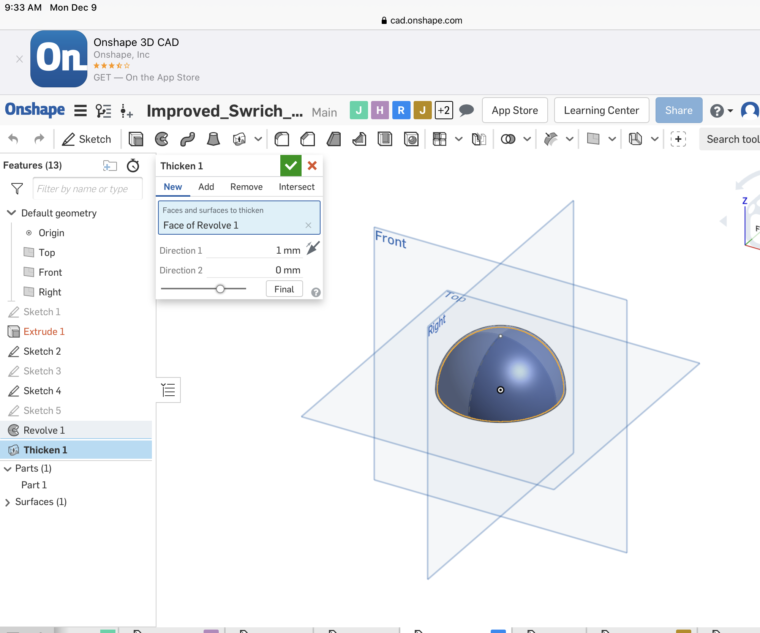
Onshape vs SOLIDWORKS at a glance
| Decision area | Onshape | SOLIDWORKS |
|---|---|---|
| Core architecture | Cloud-native CAD and PDM using database-backed Documents | Installed Windows CAD using referenced part, assembly, and drawing files, with connected cloud services |
| Best general fit | Distributed teams, rapid collaboration, multi-device access, automatic version history, and low server or deployment overhead | Established mechanical engineering teams needing deep desktop workflows, native compatibility, specialist products, and mature company standards |
| Model organization | Part Studios can create related parts together; Documents contain CAD tabs and other project data | Parts, assemblies, and drawings are normally separate referenced documents |
| Collaboration | Simultaneous editing, comments, follow mode, permissions, history, branches, and merges are built into the platform | Cloud Services support browser review, markup, sharing, and CAD-aware revision management; PDM and platform options extend control |
| Deployment | Supported browser with internet access and WebGL; mobile applications are available | Local Windows installation with defined workstation requirements and connected services |
| Broader ecosystem | FeatureScript, REST API, integrated and partner cloud applications | Large add-in, API, reseller, simulation, CAM, electrical, PDM, visualization, and training ecosystem |
Compare the exact plans and products in each proposal. Neither vendor’s portfolio page proves that every listed function is included in the licence being quoted.
The fundamental difference: database platform versus CAD files
Onshape stores design data in cloud-native Documents rather than treating each part, assembly, and drawing as an independent operating-system file. A Document can contain Part Studios, assemblies, drawings, imported data, images, PDFs, and other tabs. History is captured automatically, while versions create named, immutable points in that history.
Branches let a team explore alternatives without copying a project folder, and approved work can be merged. Multiple users can work in the same design environment without the check-out lock used by traditional file vaults. This is a practical architectural difference, not just remote file storage.
SOLIDWORKS normally uses separate .SLDPRT, .SLDASM, and .SLDDRW files connected by references. This structure is familiar, portable, and compatible with many existing suppliers and automation systems. It also requires disciplined naming, folder, reference, revision, and backup practices. SOLIDWORKS PDM or CAD-aware cloud storage can manage those relationships more safely than ordinary network folders.
For another file-based desktop comparison, see SOLIDWORKS vs Inventor. Teams evaluating a different cloud-connected model can also review Fusion 360 vs SOLIDWORKS.
Part Studios versus separate part documents
Onshape Part Studios can create multiple geometrically related parts in one modeling context. Shared sketches, variables, surfaces, and features can drive components that must fit together. Parts are then inserted into assemblies where their motion and product structure are defined.
This is useful for mechanisms, enclosures, frames, and products whose components share interfaces. It does not mean every project belongs in one Part Studio. Reuse, release ownership, performance, and team responsibilities still require a sensible Document structure.
SOLIDWORKS typically models each manufactured component in its own part document, although multibody parts, master-model techniques, layout sketches, weldments, and in-context assembly design can capture related geometry. Separate files align well with conventional part numbering and PDM but can make reference management more visible.
Parametric modeling and direct editing
Both systems use constrained sketches and ordered features to capture design intent. Extrudes, revolves, sweeps, lofts, holes, fillets, shells, surfaces, patterns, and sheet-metal operations are familiar in both. Both also provide direct-editing tools for imported or existing faces.


Individual command dialogs differ, and old comparisons can become inaccurate as products change. A missing checkbox does not necessarily mean a workflow is impossible; it may use a different feature or sequence. Test the actual features used by the company rather than scoring isolated toolbar differences.
Assemblies, mates, and configurations
Onshape assemblies use mate connectors and mate types to define component relationships and motion. Named positions, patterns, replicate tools, standard content, interference checks, and configurations support product variants and mechanism layout. Part and assembly configurations can control dimensions, features, properties, parts, and mate values.
SOLIDWORKS assemblies reference parts and subassemblies and use mates, patterns, configurations, display states, envelopes, and large-assembly tools. Configurations can create families of parts and assemblies with different dimensions, features, components, and properties, while design tables and equations support automation.
Do not assume either platform handles an assembly of “any size.” Component count, geometric complexity, patterns, imported data, references, configurations, network conditions, browser or workstation performance, and modeling discipline all affect results. Benchmark a representative assembly and drawing cycle.
Drawings, BOMs, and manufacturing documentation
Onshape creates associative drawings from sketches, parts, surfaces, and assemblies. It supports multiple sheets, standard and custom views, dimensions, GD&T, surface finishes, callouts, balloons, tables, BOMs, and company templates. Drawings stay connected to design and release data.
SOLIDWORKS has a mature associative drawing workflow with model views, sections, details, dimensions, model items, annotations, balloons, BOMs, revision tables, custom properties, and drawing standards. Its installed base is an advantage when suppliers and customers already exchange native SOLIDWORKS drawings and templates.

Drawing capability should be tested with the company’s hardest released sheet, not a simple sample. Check templates, projected and section views, GD&T, dual dimensions, weld symbols, hole tables, revision control, PDF and DWG output, and update time after a model change.
Collaboration and design review
Onshape’s architecture makes collaboration a core strength. Authorized users can edit a design simultaneously, see presence, follow another user’s view, comment in context, and share controlled links. Every edit is associated with history, and permissions can be changed without retrieving a file already sent by email.
It is inaccurate to describe current SOLIDWORKS collaboration as simply archaic. The official SOLIDWORKS Design overview describes included Cloud Services for secure browser sharing, markup, feedback, CAD-aware storage, and revision management. SOLIDWORKS PDM and 3DEXPERIENCE-connected options support more formal team processes.
The difference is architectural and operational. Onshape collaboration and history are inseparable from the CAD data. SOLIDWORKS can combine desktop CAD with cloud or vault workflows, which offers deployment choice but requires the company to define and administer the chosen path.
Version control, release management, and PDM
Onshape automatically records workspace history and supports versions, branches, merges, where-used information, and release processes. Formal release management, company controls, analytics, and custom workflows depend on the plan. The official Onshape PDM overview explains the database-backed approach and integrated product history.
SOLIDWORKS teams can use included cloud revision services or deploy SOLIDWORKS PDM for file-vault workflows, permissions, states, approvals, revisions, and replicated engineering data. Companies with an established PDM vault, ERP integration, custom add-ins, or released native files should include migration and process rebuilding in any Onshape business case.
Internet access, hardware, and IT
Onshape requires internet access. It runs through supported modern browsers and depends on WebGL, graphics acceleration, latency, and reliable connectivity. Cloud computation reduces some local workstation and server requirements, but the browser still renders interactive geometry. Large displays, complex models, integrated graphics, VPN routing, and poor network conditions can affect the experience.
SOLIDWORKS Design is installed on Windows and can continue core local CAD work without a continuous internet connection, subject to licence, cloud-service, and network-data requirements. It normally demands a validated workstation configuration, local storage, deployment, updates, and backups or managed data infrastructure.
A remote or travelling team should test outages and weak connections explicitly. A factory with unstable internet may prefer local CAD availability. A distributed team that struggles with VPNs, file replication, and version conflicts may value Onshape’s architecture more.
Measurement and inspection tools
Both platforms can measure geometry, inspect mass properties, section models, and check design conditions. The interfaces and selectable entities differ. Old screenshots can show a command gap that has since changed or can be solved another way.


Use representative inspection tasks in the pilot: point-to-point, projected, minimum, centre, face, edge, section, clearance, mass, and assembly-interference checks. The useful metric is whether the team can answer manufacturing questions accurately, not which dialog contains more fields.
Sheet metal, simulation, CAM, and rendering
Onshape includes sheet-metal design with synchronized folded, flat, and table views. Onshape Simulation supports integrated linear static and modal analysis for parts and assemblies, and CAM Studio provides cloud-native machining workflows. Rendering and specialist applications are available through current platform capabilities and partners. Plan entitlements must be confirmed.
SOLIDWORKS provides established sheet-metal, weldment, mold, routing, simulation, CAM, costing, and visualization paths across its packages and connected products. Some capabilities are included at specific tiers while advanced analysis, machining, electrical, PDM, or rendering needs may require additional products or roles.
Compare equivalent deliverables, not brand portfolios. Test bend rules, flat patterns, DXF output, toolpaths and posts, solver types, contacts and meshing, rendering quality, and data continuity with the exact licences proposed.
Automation, APIs, and specialist ecosystems
Onshape FeatureScript lets users create custom parametric features in the same language used for many native features. Its REST API and cloud integrations support automation, configurators, and connections to business systems. Because deployment is centralized, a released custom feature can become available without updating each workstation.
SOLIDWORKS has a large API, macro, add-in, reseller, and partner ecosystem built over decades. Many companies already depend on design tables, VBA or .NET automation, custom properties, DriveWorks, CAM, simulation, PDM, ERP connectors, and supplier tools. Inventory those dependencies before migration.
File compatibility and migration
Onshape can import common native and neutral CAD formats, including SOLIDWORKS data, and can manage imported files inside Documents. Translation does not preserve every sketch, feature, mate, configuration, equation, drawing annotation, custom property, or external integration. Exporting from Onshape to SOLIDWORKS has the same design-intent limitation.

Test current customer and supplier files, including a difficult assembly and drawing. Check units, geometry, assembly hierarchy, metadata, configurations, colours, surfaces, BOMs, and the time needed for a late edit. The guide to files SOLIDWORKS can open explains why extension support alone does not guarantee an editable result.
Learning, support, and hiring
Onshape is accessible from a link and removes installation and file-management setup, which can make onboarding easier. Users still need to learn sketches, features, Part Studios, mate connectors, configurations, drawings, versions, branches, releases, and company standards.
SOLIDWORKS has a larger established pool of trained users, certifications, resellers, courses, and company examples. That reduces hiring and supplier risk in many Canadian manufacturing markets. Its depth also means users must learn references, feature order, configurations, assemblies, drawings, and the company’s data-management rules.
Teams comparing other accessible parametric systems can review FreeCAD vs SOLIDWORKS. Organizations evaluating larger enterprise workflows may find NX vs SOLIDWORKS useful.
Licensing and Canadian cost comparison
Onshape is subscription based. Its Free plan is for non-commercial projects and its Documents are public, so it is not suitable for confidential client, employer, or patent-sensitive work. Private commercial work requires an appropriate paid plan. Release management, simulation, enterprise security, analytics, and integrations vary by plan.
SOLIDWORKS offers different named-user, device, term, network, and reseller deployment paths, with package and regional variations. Cloud services, PDM, simulation, CAM, and specialist roles must be matched to the proposed workflow.
Canadian buyers should request comparable CAD-dollar quotes including subscriptions or maintenance, required modules, implementation, PDM or release setup, migration, training, support, tax, workstation changes, storage, and business-system integration. Avoid comparing a complete platform on one side with a base CAD licence on the other.
Which one should you choose?
Choose Onshape when
- Engineers, suppliers, and reviewers are distributed and need controlled browser access.
- Simultaneous editing, automatic history, branching, merging, and link-based review solve real process problems.
- The company wants CAD and data management without maintaining workstation deployments or PDM servers.
- Part Studios and cloud automation fit the product architecture.
- Reliable internet access is available wherever design work occurs.
Choose SOLIDWORKS when
- Customers, suppliers, staff, templates, macros, and released data already depend on native SOLIDWORKS files.
- Local desktop availability and predictable workstation control are important.
- The company relies on specialist SOLIDWORKS simulation, CAM, electrical, routing, PDM, or partner workflows.
- A large hiring, reseller, certification, and support ecosystem reduces operational risk.
- Migration cost and native-data continuity outweigh cloud-native collaboration benefits.
Consider a staged or mixed workflow when
A new product team may pilot Onshape while legacy products remain in SOLIDWORKS, or outside reviewers may use SOLIDWORKS cloud review while authors remain on desktop CAD. A mixed environment is worthwhile only when ownership, revision handoff, native deliverables, and the source of truth are explicit.
Run a representative pilot
- Choose a real product with related parts, configurations, an assembly, sheet metal, and production drawings.
- Make the same late engineering change in both systems and update every affected drawing and BOM.
- Have two designers work concurrently while a reviewer comments and approves a revision.
- Import a difficult customer assembly and export a supplier deliverable in the required format.
- Test the required simulation, CAM, rendering, automation, or business-system connection.
- Measure open, update, drawing, release, and recovery time on the actual network and hardware.
- Record training, migration repair, administration, support, add-ons, and three-year cost.
Frequently asked questions
Can Onshape replace SOLIDWORKS?
Yes, for some teams. Onshape can cover professional mechanical parts, assemblies, drawings, configurations, sheet metal, and connected product-development workflows. Replacement is harder when customers require native SOLIDWORKS files or the company depends on specific SOLIDWORKS add-ins, PDM, macros, templates, simulation, CAM, or released legacy data.
Is Onshape less powerful than SOLIDWORKS?
That is too broad to be useful. Each has workflows the other handles differently, and package boundaries matter. Onshape is especially strong in cloud-native data management and collaboration; SOLIDWORKS has an especially broad installed ecosystem and specialist portfolio. Test the exact work rather than ranking brand power.
Can Onshape work offline?
Onshape requires internet access for normal CAD work. It is not the right primary authoring system where reliable connectivity cannot be maintained. SOLIDWORKS core desktop CAD can work locally, although licensing, shared files, PDM, and cloud services may still depend on network access.
Is Onshape Free private?
No. The Onshape Free plan is for non-commercial use and its Documents are public. Use an appropriate paid plan for confidential or commercial work and verify current terms before uploading intellectual property.
Final verdict
Onshape is the stronger choice when cloud-native collaboration, automatic history, branching, multi-device access, and simpler IT directly improve the company’s engineering process. SOLIDWORKS is the lower-risk choice when native compatibility, desktop workflows, specialist products, existing automation, and a large established ecosystem dominate. The right answer should come from a controlled pilot that tests design changes, drawings, data management, connectivity, and downstream manufacturing together.


